
What the hell is marketing?
This is relevant question today because everyone seems to point to marketing as THEE key to success. And yet, definitions and expectations diverge wildly about what marketing is and what it is not. Mostly it seems to be misunderstood, misused or both. At Re:Sourceful, we say > Marketing builds and/or solidifies relationships with customers, so they buy from you and keep buying – even when they have other options.
We view it as the beginning of the sales process. Great marketing can sell in some cases, but the days of interruptive marketing or 'advertising' having the ability to grasp someone's attention and get them to act/buy are mostly long gone. Sure it may still work for some markets and some demographics, but even those options are slipping away rapidly. For every way we have to talk with our customer, they have a method to block or shield themselves.
Most of our partners are in the telecommunications industry, and changing/threatening regulations and rising costs are major issues for companies and the customers they serve.
So, where does that leave marketing? Possibly in a very good place if we are willing to change our approach, and change it dramatically.
Healthy relationships at any level are two-sided. They are about listening, caring and acting to the benefit of other person. Business relationships are exactly the same. For years most companies didn't treat them this way because they couldn't or didn't want to make the effort. Today, tools exist to better accommodate one-to-one communication and relationship building interaction, if you are willing.
In my view, these are some steps toward change that may help:
1) You need a truly great collection of talented people. Experts that have the ability to build and enhance relationships through sharing their knowledge for the benefit of customers. If you don't have them, you need the guts to go get them. You may have to move some people to other seats or off the bus all together.
2) Your entire staff needs the desire to communicate your collective expertise and then demonstrate that your people are the authority on the subjects in which you talk/write/share. If you have the desire, you will find the methods you need.
3) And most importantly, you need to transform your company into a sales organization. I'm not talking about some sleazy Glen Gary Glen Ross type, but rather, an organization that has enough discipline and caring to monitor, track and nurture individual relationships - of both longtime customers and prospects. So you can listen and respond quickly, if needed, in the format desired by the customer.
These ideas are not new, nor are they tremendously difficult. However, in order to do them you have to stop doing some things, and you might need to significantly retrain or change some of your workforce.
Marketing is not a department. It is a mindset which needs to reside in all areas of a company, if you want to be successful.
What are you reading?
Seriously. What are you reading? If you want to grow professionally, you need to read books. Yes, blogs can be great and articles can be good, but nothing helps the mind consider new things like books.
I was not huge fan of reading for fun or growth after college until a friend of my wife introduced me to Nelson DeMille. Then, I re-learned to love reading - like I did when I was a child.
Then, after I started my company, I started to read a lot of business related books - until it became a habit. The audio books were my addiction for a time - starting with tapes, then CDs and finally on my iPod. Hard cover books are still great, but my new favorite way to read is on my iPad.
DeMille and John Grisham are two fiction writers I go to for vacation reads, but there are many others too. As for business writers, I like Malcolm Gladwell, Seth Godin, and Patrick Lencioni.
Read The Tipping Point, Outliers or David & Goliath by Gladwell. Or, read Permission Marketing by Godin…or any of his other stuff. Start with 5 Temptations of a CEO by Lencioni - and you don't have to be a CEO to learn a ton from it.
My current favorite book is by Jay Baer, and it's called YoUtility. If you are in marketing, own a business or want to sell anything from today on - it is MUST read.
So, I'll ask again. What are you reading right now?
Be quick but don't hurry
John Wooden is a great basketball coach. One of his many great sayings/quotes is "Be quick, but don't hurry." Honestly, that is some of the best advice I've ever absorbed and it applies in so many areas of ones life. And it applies well to marketing too. Often there are many tasks that need to be done and all seem ultra important, but most often there are a few big rocks that really need to be done first AND done very well. So, hustle. Work hard. Be diligent. And most of all, be quick but don't hurry-the process, the hire or the project. Great sometimes takes just a little bit more.
Replace search for silver bullet with hard work
The story is the same. Everyone is looking for a silver bullet. The perfect recipe, or that one-hit to make the money flow in and their job easier. While the truth is that most success is earned through struggle, hard work, adjustment and perseverance. This is true in many areas of life and marketing is no exception. Marketing folks are tempted just like everyone to run to the hot new and shiny item of the day/month/year. Every 'traditional' or 'old school' method of marketing was at one point a shiny new toy.
The quiver of arrows just gets bigger, and the customer's ability to shield themselves grows as well. But the temptations that remain are: A) use them all or B) find the one or two 'that work' and use them exclusively.
Neither of these options are correct for everyone, and to suggest otherwise would overly simplify customers. Humans are complex and their buying decisions are immensely diverse. However, the one thing they want is to feel a connection with a company or brand. Yet, how that feels and is translated is different for everyone.
We often say this is a relationship or experience we want the customer to have with our company. Most of the time it is a human connection and at other times it is a feeling or sense of understanding that defies definition. But with any relationship, asking for permission is almost always welcome and further builds the bond.
Work hard with building relationship with customers by getting their permission to serve them. Your efforts will pay off for both of you.
Words and emotions
Words used correctly in marketing should evoke emotions. I didn't start out to be a writer and I could argue that I'm not one now by some definitions. But, I spend most of my professional time shaping words to cause action, illicit a response or to deliver an important message, so in that sense I'm a writer - or at least a communicator.
Emotions are part of the communications system. People have an emotional connection to all sorts of things and not all of them make sense, even to the person holding them. However, to connect with someone's rational and calculating side, you must first tap into their emotions; and that connection to the emotions must be real.
In order to be real, you must understand your audience well enough to know what matters to them. In short, you need a relationship with them.
A wise coach once told me, "Rules before relationships will lead to rebellion."
Another saying which applies is: People don't care how much you know, until they know how much you care.
Get to know your audience as deeply as you can in all the ways you know how. Then, connect with them inside that relationship. You'll be amazed at the results.
The benefit of fear
Fear. The word alone makes palms sweat and guts wrench. But, fear can be good for people and organizations, if it's dealt with openly and honestly. It can keep you focused on a goal and away from danger. Fear can motivate you if it doesn't paralyze you.
Effectively dealing with fear can't be done without managing your emotions because it's difficult to think clearly when your mind is overwhelmed.
Draw on your patience. Look at your plan. Engage your people.
Fear brings focus. Use it to your benefit.
The Helpful Gene is critical to a strong organization
Being helpful is a trait that is taught early to children in the US. Some take to it easily and

others not as much. There certainly are studies about how personality type and birth order affect helpfulness, and like most research you can find some to make whatever case you care to make.
But, I'll say this: when you look for staff members, or vendors of any type, helpfulness should be a key hiring trait. It's a primary key to long-term success.
Helpfulness is a personality trait. To those that have it, it's ingrained. Those that are truly helpful LOVE to help people, sometimes even those that don't want to be helped. Which can cause problems for the 'helper' that has yet to rein in their gift.
I'm a helper. I've been that way for as long as I can remember. Over my life it has caused both joy and pain, as I learned where and when helpfulness was - well, helpful.
On the surface, and maybe even down a few layers, this post might seem self-serving. And I suppose it is to some extent. Since I am helpful, I view it as a valuable and necessary skill. But this post goes much deeper than being self-serving because it is about WHY helpful people are good for organizations.
In order to use your helpfulness you have to: see issues from other's point of view, understand the big picture, develop solutions that really solve problems, and you might have to become good at presenting on topics/issues that no one wants to discuss or talk about. You have to care and, more than that, you have to care about the people affected, and to understand the issues from the business side and the customer's side.
So, consider what questions you can ask to uncover if your next vendor or employee is a helpful soul. Their long-term value to your organization will be directly correlated to their helpfulness.
An Untouchable lesson: What are you prepared to do?
I love the movie The Untouchables. Like all great stories it has layers. Very often those layers provide opportunities for teaching or learning if you're inclined to consider the full context of the scene, dialogue or situation. The scene below is just such an occasion.
What are you prepared to do?
Not in the context the film uses, but rather what are you personally or professional prepared to do? What is your company prepared to do?
It is an invitation to answer the call, if you are prepared to act, or to prepare yourself if you are not.
Maybe you need a plan. Or, maybe you just need to just follow the plan you have in place. Possibly you need to make some hard choices. Or, it might just be you need to buckle down and do whatever is in your path.
So, what are you prepared to do? Action is required. It is your move.
Ditch the jargon, make more sales
I didn't think this topic needed to be covered again, but apparently it does.

When you are selling anything to anyone or when you are developing a product or service, for crying out loud please don't use industry jargon or acronyms. Not ever.
If you currently have some in your sale literature or on your website, please start purging it immediately.
The reason, which is apparently not as clear as it should be, is that customers don't know what the heck your lingo means. Nor do they care. And, when they don't know, guess what they do? The leave and buy from someone else unless you are family, and then they still might leave.
Few customers set out to learn a new language when they are trying to buy something, and if they do want this they can get their fix with Google while researching.
If you get into the sales process far enough you might need to introduce some 'tech spec' talk in order to draw a distinction, but you certainly don't need to lead with this stuff - even if the buyer is an IT manager. Shoot, even they like simple - easy to understand language.
Ditch the jargon and you'll have the opportunity to make more sales.
The angry customer hat
When was the last time you took a hard look at your organization's products or policies? I'd suggest you do it today and before you do, put on your "angry customer hat."
As its name implies it helps you remove your 'insider' glasses, industry knowledge and justifications, so you may consider how your products or policies might be viewed from your customers' perspective.
This is harder to do than it may sound.
Read your copy in your product flyers, catalogs or ads. Look for ways it could be misunderstood or twisted. Consider your marketing campaigns with this hat on a month before your launch them, so you have a chance to adjust as needed.
If you need some help getting in the right 'angry' frame of mind, ask your front line staff. Sales or customer service people can provide you some real world feedback which they hear everyday. It will get you going the right direction, with the right intentions.
Now comes the critical part of this process. Just because someone might try to twist something doesn't mean you need to change it, but it does mean you need to be ready with your answer and maybe a sense of humor.
Most certainly, you want to be sure you are clear - beyond reasonable misunderstanding.
And, you want your product or policy to make logical sense. Does it have a solid basis? Is it smart.
Doing this well, will save you and, more importantly, your sales, customer service or installation staff a lot of headaches. If you don't know where to start, think about places where customers first interact with your company. Start there with your angry customer hat.
Marketing is a medley relay
You've heard the saying "Success is a marathon, not a sprint." I agree, but I'll add that marketing, or I should say 'great marketing' is a medley relay. In order to do great things, your organization needs to collectively own marketing. Everyone from Accounting to HR to Operations to Sales to C level are in the marketing. That is not because marketers are control freaks (a topic for a different post), but it is because marketing is an organizational trait rather than a department.
Because this is true, in order to be great with your marketing you need to practice hand offs and run your leg and cheer your teammates and carry warm ups and guard the baton and hold the blocks and train to win.
Everyone runs a leg. It might be short like the 100 meters or long like the 1600 meters, but each leg is critical to your success. Marketing is exactly like this.
Are you using your whole squad in your marketing? What can you do today to get everyone in training for your medley relay?
What does 'smart' look like in your company?
"The scene at mission control was what smart looks like. Retrorockets could have eased the Curiosity straight down to the surface, but that would have stirred up too much dust, perhaps fouling its works before it even got started. So the engineers chose the hard and creative and dangerous solution for the simple reason that it was also the best one." Time Magazine, Live From Mars, by Jeffrey Kluger
Scientists may spend a lifetime working on one problem. When I read about their  efforts, the job of marketing seems so small by comparison. Then I remember that even if marketing is often devalued, great communication never is, and ultimately that is what great marketing delivers.
The challenge is that great is not easy. Great is hard, pain staking, time-consuming and frustrating work. However, great results are so exhilarating that you'll want work twice as hard as before.
Which brings us back to the question, 'what does smart look like in your company?'
Like creativity, 'smart' looks and acts differently in people and organizations. Many companies spend too much time reacting and not nearly enough time 'pro-acting.'
What do you need to do to make your company use the 'smart' you already have in your company?
Pushy sales people make more sales
Apparently some people believe this to be true. Why else would they do it? Some are certain to argue that it must work or they would not do it. I'll grant you that it might work - ONCE.
But, most sales related jobs rely on repeat business and referrals. You won't get many if you are pushy.
Note - Asking for the sale is different, but you can do that without being pushy.
If you create a positive experience, consistently for your customers you will make more sales. I know the training manual might say that once they leave the showroom/office/lot you have xx.x% less chance of making the sale. However, if the customer dislikes the experience they won't buy from you at all, or they will resent it or you. They sure won't refer you.
Be human. Ask questions. Be authentic. Address concerns. Don't push.
Why you are not creative!
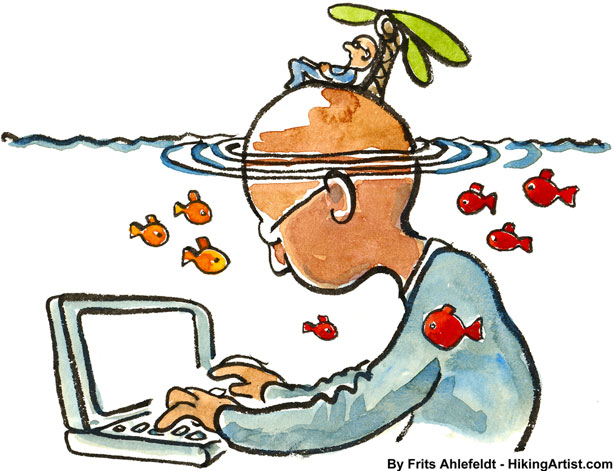 Some people and personality types are more creative than others, there is no question about that fact. However, everyone is creative no matter how it's defined. Many just don't think of their skills as creative.
Their reasons are numerous. One I'd like to remove from the list comes from too tightly defining what creativity is.
Some people and personality types are more creative than others, there is no question about that fact. However, everyone is creative no matter how it's defined. Many just don't think of their skills as creative.
Their reasons are numerous. One I'd like to remove from the list comes from too tightly defining what creativity is.
Creativity is finding a new way to fund R&D. Creativity is setting up a network to better utilize your hardware or help your staff. Creativity is hiring the people who will lead your company 10 years from now. Creativity is looking at a problem from a different perspective. Creativity is finding a way to do something - when a common path is blocked.
You'll notice that I didn't mention anything about marketing, design or the arts. Certainly that is how many define creativity, and those are valuable pursuits, but they don't hold exclusive rights to creativity.
To unleash creativity and action in your organization, make a point to publicly redefine creativity. Then, encourage new thinking about old processes. You'll be delighted by the results.
Consistency may make you remarkable!
If you are relentlessly consistent people will notice and reward you. Shoot, you'll be a hero! Think of all the times and situations when you value consistency.
- Policy application at a company with whom you do business
- The umpire's strike zone
- Driving your car - or how others drive theirs
- Policy application at your company
I know there are many more or subsets of those above, but you understand the point.
We tend to notice when someone is inconsistent because it upsets the balance. We calibrate our expectations based on experience. When that experience changes, we get confused. If it changes in a negative way, we get frustrated. The converse it also true.
Notice I said 'someone' is inconsistent. I didn't say a company is inconsistent because it is individuals that make consistency decisions. A company that recognizes inconsistency in their staff will train accordingly and reap the benefits.
This week look for ways you or your company can become more consistent. Then, take steps to make it happen. Both your bottom line and your customers will love you for it.
Clear communication is the next killer app
Mark my digital words. Clear, well-considered communication will be a trait that makes someone a lot of money in the next 20 years. Most certainly that communication will be about a product or service that is remarkable, but chances are someone will use their great communication skills to develop something worth talking about, or at least to build the team to create the product.
We are connected and communicating more than ever before - and often saying less. Certainly the speed in which communication is allowed contributes to our inefficiency. Inefficiency in this case = noise. When there is noise we invent things like mute buttons, caller ID, and spam filters.
I love having choices about how we may communicate with one another, but eventually everyone gets weary of noisy chatter and wants something of substance: a challenge, a conversation, a book or a great product that solves one of life's hurdles.
Foster clear, concise communication for yourself and those around you. It will set you apart and it might even make you or your company remarkable. Now that's something worth talking about.
Truth, Lies and Stories
I don't know about you, but I really don't like it when someone tells me something that is factually true, but is untrue when the full context of the situation is known. This is not a political article, although political ads provide plenty of examples of trying to persuade by withholding the complete truth. From my point of view this is worse than a straight out lie - because the communicator is attempting to manipulate you by telling part of the story.
Politics certainly does not have a corner in the lying market. Plenty of companies stretch the truth a little or a lot.
Nothing will damage your reputation or brand more quickly than lying. People will find out and when they do they will not be happy. Chances are they will tell A LOT of people about the falsehood and your brand.
Be straight forward and honest in all of your dealings and you will be rewarded. Own mistakes, tell the truth, and have a great product or service. Customers will flock to you.
Now, it is important to remember that you don't have to make buying decisions for customers with your honesty. I've seen companies attempt to be so transparent that they nearly talk customers out of buying something even though the customer would benefit from the product.
Present the product fairly. Be straight forward, but the role of marketing is to entice interest and inform. If you have a concern you want to be discussed when a customer calls - make sure it is on the campaign summary you provide to sales people, so they discuss it with customers (or at least make sure the issue is understood) before the sale is finalized.
A veteran sales person shared this with me long ago and I have not forgotten it: always tell the truth, it's easier than trying to remember who you lied to!
Marketing is trivial
I had something else planned for today, but it seems trivial now. I'm not devaluing learning and growing in your profession as a marketer, salesperson or executive. But, I want to be somewhat more personal.
Events recently in Aurora, CO or in Evansdale, IA and Penn State need to make us pause  and consider how we treat one another. Further, if we know someone is struggling - a little or a lot, we need to act. First to help them and second to protect others. Helping doesn't need to be filled with drama; often small acts may redirect someone's path in a better direction for them and ultimately others.
We live in one big community, and while we have our different customs and priorities, people want largely the same things: Opportunities for success and safety for themselves and their families.
We are all in a position to help someone and sometimes the moment to help comes up quickly. Other times you can see it coming and prepare. Regardless, please take the opportunity to help those you touch using compassion and persistence.
They will benefit. You will benefit and others you don't even know may benefit.
Thanks for all you do. Blessings to all.
Process = Success
If you implement anything more than a few steps long you have a process. Done well a process is your friend. It helps marketers or  executives to insure you cover important bases and don't miss things. A good process is not static and improves over time.
An example from my daily work is our review process for newsletters - both electronic and printed. The process has saved us many times from making errors both BIG and small. We use similar processes for campaign themes and various other projects, as well. It works like this.
executives to insure you cover important bases and don't miss things. A good process is not static and improves over time.
An example from my daily work is our review process for newsletters - both electronic and printed. The process has saved us many times from making errors both BIG and small. We use similar processes for campaign themes and various other projects, as well. It works like this.
- We prepare and send a "First Look" which is mock up of the piece. It might have full stories and graphics in some places and ideas for stories in other places. It prompts the discussion.
- We prepare the newsletter based on feedback and send what is a 98% complete document to make sure the content we've developed follows the feedback/discussion provided in the First Look session. We state this is not polished, but should be close and we talk about any holes that still need filling (the 2%). We ask for a keen eye review.
- Following comments/suggestions/corrections, internally we do what we call the FTC (fine tooth comb). This is a detailed review where you re-read every word and you need to be in full editor mode. After writing and laying something out - often you can't see the forest for the trees, so you need extra keen eyes at this point.
- After FTC, we send the final out for approval. If someone finds something, we fix it. Most often, it is approved and we order.
This process works because it has been developed over time and everyone knows what to expect. We use it consistently and participants know what is needed at each step. It makes it easier for all involved AND we get the best results because of it.
What processes do you use to make your tasks easier to accomplish? An advice to make our process better? I love to learn.