
What the hell is marketing?
This is relevant question today because everyone seems to point to marketing as THEE key to success. And yet, definitions and expectations diverge wildly about what marketing is and what it is not. Mostly it seems to be misunderstood, misused or both. At Re:Sourceful, we say > Marketing builds and/or solidifies relationships with customers, so they buy from you and keep buying – even when they have other options.
We view it as the beginning of the sales process. Great marketing can sell in some cases, but the days of interruptive marketing or 'advertising' having the ability to grasp someone's attention and get them to act/buy are mostly long gone. Sure it may still work for some markets and some demographics, but even those options are slipping away rapidly. For every way we have to talk with our customer, they have a method to block or shield themselves.
Most of our partners are in the telecommunications industry, and changing/threatening regulations and rising costs are major issues for companies and the customers they serve.
So, where does that leave marketing? Possibly in a very good place if we are willing to change our approach, and change it dramatically.
Healthy relationships at any level are two-sided. They are about listening, caring and acting to the benefit of other person. Business relationships are exactly the same. For years most companies didn't treat them this way because they couldn't or didn't want to make the effort. Today, tools exist to better accommodate one-to-one communication and relationship building interaction, if you are willing.
In my view, these are some steps toward change that may help:
1) You need a truly great collection of talented people. Experts that have the ability to build and enhance relationships through sharing their knowledge for the benefit of customers. If you don't have them, you need the guts to go get them. You may have to move some people to other seats or off the bus all together.
2) Your entire staff needs the desire to communicate your collective expertise and then demonstrate that your people are the authority on the subjects in which you talk/write/share. If you have the desire, you will find the methods you need.
3) And most importantly, you need to transform your company into a sales organization. I'm not talking about some sleazy Glen Gary Glen Ross type, but rather, an organization that has enough discipline and caring to monitor, track and nurture individual relationships - of both longtime customers and prospects. So you can listen and respond quickly, if needed, in the format desired by the customer.
These ideas are not new, nor are they tremendously difficult. However, in order to do them you have to stop doing some things, and you might need to significantly retrain or change some of your workforce.
Marketing is not a department. It is a mindset which needs to reside in all areas of a company, if you want to be successful.
Hello Asana
I love products that help me manage workflow, and to be more efficient. No product can MAKE you be productive and efficient, but they can help. I've used DayTimer, Franklin Planner, Outlook and Palm Desktop. I've read Steven Covey and David Allen. I've learned something from all of them over the years. I've become mostly aligned with David Allen's Getting Things Done approach. If you are not familiar, do yourself a favor and check it out.
About 6 months ago I learned about Asana. It is a web-based team task management system. I've not adopted their model to use it to replace inter company email yet, but maybe I should. Asana is flexible, and yet offers enough structure & assistance to get you started with ease.
If you are in the market for something like this, Asana might be the answer - and it is free for small companies and very reasonably priced for others.
My favorite tip I've learned over the years is a way to manage tasks/questions I've delegated to others. David Allen calls it @Waiting For. I just use Waiting For. In our case it is a tag in Asana, but there are many other ways to use this idea.
Good luck and enjoy!
Do something that matters
It is my assumption that everyone wants to do something that matters. I'm far from positive about this, but it just makes sense to me. The opposite is people just want to feel like failures much of the time - and I just can't see anyone wanting that. So then the questions are these:
1) What is it that matters?
2) Can I do something that matters here or do I need to go somewhere else to do it?
The answers (as I see them) are:
1) What do you have a passion about? I'll bet others do to AND would benefit from your passion, understanding and expertise. Share it and watch what happens.
2) Yes. There is not a perfect place or ideal time. Certainly timing can be important, but if you wait to find the right mix of whatever you are waiting for - you will never even start.
Good luck. Let me know how it goes for you!
New jobs, old jobs and telling the difference
Seriously, how do you view your role in your company? What are your boring, routine tasks AND what are your larger responsibilities?
Certainly we all need the ability to 'turn off' work and not carry around the problems, challenges and blessings we experience in the workweek. And yet, we are in a 'always on' world. Staff, who doesn't at some level appreciate and respond well to this fact, may find their seat at the table moved or removed. Organizations today need people who create solutions where only problems existed before, or to create value where expense was the common viewpoint.
Because it is so thought-provoking, I'm not just providing a link to blog post - but I'm also including it right here. Enjoy the content then consider your role and those of people around you.
Who goes first? Initiating a project, a blog, a wikipedia article, a family journey--these are things that don't come naturally to many people. The challenge is in initiating something even when you're not putatively in charge. Not enough people believe they are capable of productive initiative.
At the same time, almost all people believe they are capable of editing, giving feedback or merely criticizing.
So finding people to fix your typos is easy.
I don't think the shortage of artists has much to do with the innate ability to create or initiate. I think it has to do with believing that it's possible and acceptable for you to do it. We've only had these particular doors open wide for a decade or so, and most people have been brainwashed into believing that their job is to copyedit the world, not to design it.
That used to be your job. It's not, not anymore. You go first.
The benefit of fear
Fear. The word alone makes palms sweat and guts wrench. But, fear can be good for people and organizations, if it's dealt with openly and honestly. It can keep you focused on a goal and away from danger. Fear can motivate you if it doesn't paralyze you.
Effectively dealing with fear can't be done without managing your emotions because it's difficult to think clearly when your mind is overwhelmed.
Draw on your patience. Look at your plan. Engage your people.
Fear brings focus. Use it to your benefit.
Marketing is a medley relay
You've heard the saying "Success is a marathon, not a sprint." I agree, but I'll add that marketing, or I should say 'great marketing' is a medley relay. In order to do great things, your organization needs to collectively own marketing. Everyone from Accounting to HR to Operations to Sales to C level are in the marketing. That is not because marketers are control freaks (a topic for a different post), but it is because marketing is an organizational trait rather than a department.
Because this is true, in order to be great with your marketing you need to practice hand offs and run your leg and cheer your teammates and carry warm ups and guard the baton and hold the blocks and train to win.
Everyone runs a leg. It might be short like the 100 meters or long like the 1600 meters, but each leg is critical to your success. Marketing is exactly like this.
Are you using your whole squad in your marketing? What can you do today to get everyone in training for your medley relay?
Marketing is trivial
I had something else planned for today, but it seems trivial now. I'm not devaluing learning and growing in your profession as a marketer, salesperson or executive. But, I want to be somewhat more personal.
Events recently in Aurora, CO or in Evansdale, IA and Penn State need to make us pause  and consider how we treat one another. Further, if we know someone is struggling - a little or a lot, we need to act. First to help them and second to protect others. Helping doesn't need to be filled with drama; often small acts may redirect someone's path in a better direction for them and ultimately others.
We live in one big community, and while we have our different customs and priorities, people want largely the same things: Opportunities for success and safety for themselves and their families.
We are all in a position to help someone and sometimes the moment to help comes up quickly. Other times you can see it coming and prepare. Regardless, please take the opportunity to help those you touch using compassion and persistence.
They will benefit. You will benefit and others you don't even know may benefit.
Thanks for all you do. Blessings to all.
Purpose and passion are 'self serve'
These days you can outsource many responsibilities in your business. Often, you and your customers are better served by doing so because you  can hire great expertise at less cost than it would take to employ them in-house. You'll likely gain some efficiencies too.
But, there are at least two areas you can't hire out:
can hire great expertise at less cost than it would take to employ them in-house. You'll likely gain some efficiencies too.
But, there are at least two areas you can't hire out:
1. Your company or organization's purpose
AND
2. The passion it takes to sustain the organization or company
One can't be sure of the reason some companies try to outsource these core elements. My guess is they are tired or they are lazy.
I've seen this done under the veil of 'planning' where an organization wanted the facilitator to lead them to their passion or purpose. In reality, they were not willing to do the soul-searching work it took to get to the answers they needed. Granted, sometimes you may need the assistance of someone to help you with unpacking the 'how' of your purpose, but never the 'what'.
I urge you to do the work. If you don't know how, try this. Shut off all electronic devices and go to a place you cannot be disturbed for a few hours. Without distraction, it may not even take this long. Be sure to take a pen and a legal pad with you.
- Then, ask yourself this question: Why do people come to your business or organization?
- If you are failing and need to make a change, the question might be: Why do you want them to come to your organization or business?
- Then, ask yourself this: What really makes me excited about our business?
Discovering these answers will invigorate and excite you. If it doesn't, you have not found your purpose or passion.
How to make people care.
Many have written about this topic and the issue is not solved evidenced by an example I witnessed while traveling recently. Here's the short version: Flight was oversold in an airport full of people who had been delayed by weather, so there is a standby list. Gate agent continually begs people to give up their seat, so they can get down to the number. I'm not sure if anyone bit or not. Regardless, boarding goes on as normal.
An adult son of one of the standby passengers is on the plane. He calls Mom and says they are about to close the door and there are 5 seats available. Mom goes to gate agent saying, "Hey, please get me on that plane. My son on the plane says there are 5 open seats." Agent was about to close the door says, let me check. Turns out there were 6 seats available, so most of the stand by passengers got to go - thanks to the son.
I understand that in this situation there are MANY moving parts. Stress is huge for all involved. The airline wants to be 'on time.' However, I was struck by how little the airline staff seemed to care. They had 6 open seats on a plane leaving an airport PACKED with people and they didn't appear to be acting to fill them. Wow!
Again, I realize it is crazy for airline staff in situations like this, but what a perfect time to really care about the people standing there waiting to go - wherever they planned to go.
This situation caused a discussion among our traveling party about how to make people care. Of course, there are no quick fixes and even caring people can have a bad hour or two.
So what can you do to instill caring as part of your company culture? Here are some things to consider.
1. If you have the chance, hire to this skill. Make it one of the skills you MUST have. Department doesn't matter.
2. Make sure you model caring to your staff. Help people. Show compassion. Let them know this is who you are as a company.
3. Make your expectations clear and give them permission to fix a problem. You might need limits, but keep them general.
4. Reward employees who consider customer experience - before or during a problem.
Regardless of your industry, caring employees matter. Your company will thrive because of them while others wilt.
What are your favorite ways to make employees care?
Clarity in the sales process IS the sale!
Clarity IS the sale, and clarity may take many forms. Too many sales people, or maybe more importantly, management, do not appreciate this.
Make it easy to understand = customer buys.
this.
Make it easy to understand = customer buys.
Make it confusing = customer ignores you or moves on to buy from someone else.
Selling really is this simple. But, we make it more complicated all the time. I understand that some products or services are complex. Honestly, that doesn't really matter.
If the seller is transparent (demonstrates trustworthiness) the buyer will pick up the cue. It is easy to be clear when you are trustworthy.
Is it somewhat scary for the seller to be vulnerable? Absolutely!
Is it necessary in order to be overwhelmingly successful in any type of sales. Yep.
Often, the scary part for sales people is they don't want to be transparent enough to allow clarity to happen, so they skirt issues, they mitigate their speech, or use industry jargon for cover. The adage goes - if you can't convince them, confuse them.
Customers, not wanting to be 'taken,' are on guard all the time. They'd love to be open, but experience has taught them not to say too much for fear of losing leverage.
If you've ever had the pleasure of a transparent sales person, you know the comfort that feeling provides. Start building an organization of transparent sales people today. Your customers and your bottom line will thank you for it.
Do you feel safe to make the wrong decision?
Trust is the cornerstone of a good company, and a good family for that matter.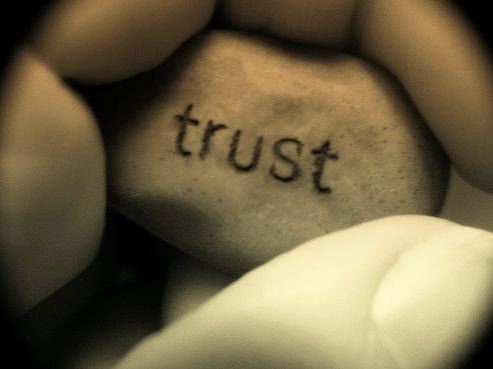 Many fathers celebrated yesterday and I’d be willing to say that many cards had words similar to “thanks for helping, protecting and loving us.” I’m glad so many fathers are deserving of such praise.
Though companies are NOT families, they need many of the same things from their leader (whether female or male): assistance, safety and love, which are the foundation for trust.
If you are a manager at any level, you are entrusted with the care of those you manage. They need to trust you. You need to trust them. This is never a one-way street and it always starts with the leader. Always.
This can be somewhat scary if you are a new leader or just starting to build your culture. You’ll feel exposed. If you do, then you’re doing this right.
When your staff feels safe to make a tough decision because they know there's a trust safety net should things go wrong, productivity will soar – theirs and yours.
Need more upside? Decisions will get better because trust leads to more open feedback on the front end, which leads to better results. Obviously, part of trust is holding people accountable to their expectations. Expectations provide the guidance everyone needs to be successful.
The best news of all is trust works for everyone from marketers to technicians regardless of industry.
I've heard many great stories about how trust has been demonstrated. What are some of yours?
Joyous impatience
My Mom gave me a cup for high school graduation that said "God grant me patience...and HURRY!" I didn't yet recognize just how impatient I was. But she knew and I soon learned.

As a marketer or product developer, always remember: impatience can KILL your chance for success in so many ways.
For starters, you need patience to create ownership in ideas or strategy. Then, you need patience to allow the plan to work. And you need still more patience dealing with staff when they say things like "do something different because this idea hasn't worked" when results are not immediate.
Over the years, I've learned how to manage my impatience (mostly). I even have found ways to use it to help me create urgency when needed - without going overboard. A sense of urgency is good, and in many companies dearly needed, but impatience is not.
Try these three things if you're impatient:
- Go slow when you want to go fast. This works for talking and actions. Try it. Obviously this is scaleable based on the situation or magnitude of the matter at hand.
- Find a healthy distraction to save you from yourself. Maybe it is a walk around the office, chewing a piece of gum or 10 push ups. Back when I could count my clients on 1 hand and worked in a home office, I would mow my lawn or take a quick bike ride rather than pester my clients. Almost always, after that 30 minute break - I'd have the email reply I needed to move the project along.
- Work on something you are curious about. If you need some help, check out Ted Talks.
Seth Godin talks about impatience in his Seven Marketing Sins post and in his interview below. Enjoy. [youtube http://www.youtube.com/watch?v=sknuiFywKLM?feature=player_embedded]
Curious George can teach you to be a better marketer
Do you hunger to want to know 'why' about stuff? Not just your 'stuff' or your company 'stuff' but everything? The more curious you are the more likely you are to understand consumers, products and how they connect - or don't.
Be curious about things. It will extend to your thinking about marketing your stuff or leading your team.
Professional boredom. What!?
 I'm sure my girls are not different than most other American students, at least when it comes to summer boredom (or at least their perception of boredom.)
You know what I'm talking about because we have all either a) been a student or b) been the parent of a student.
It plays out much the same way everywhere. Student counts down the days to the end of the year and comes home chanting 'summer, Summer, SUMMER' in their best High School Musical tones. By day two, you are certain to hear - I'm bored or there is nothing to do in the days before their summer activities kick off.
After this happened at my house, I started drawing parallels.
I know many professionals (myself included) that have at one time or another been bored in their job. They, like students with summer star in their eyes, worked or studied hard for the job or promotion. When the 'arrived' they were thrilled, like kids the day school is out for summer. They are content for a time, but when problems arise or the challenges stop coming, they get bored with their job.
How can you overcome the challenge of 'professional boredom' that many won't admit to having? Try some or all of these:
1) Read something. Professionals that don't read are going backward in their profession. Pick a book store. Find a book. Read it. Repeat. If books aren't your thing, find a new blog related to your profession or related subject and read it. Daily.
2) Take 30 minutes and clean up your work space. Often the act of organizing can help you feel more engaged. Or, you will dive into the task and it will pull you into some projects you've been dreading. Once you are into it you'll realize it isn't all that bad!
3) Use a vacation day during the week and do something you want to do - for you. Something that you won't take time for on the weekend.
4) Write down your goals or review them if you have previously written them. Are you on track? If yes, do you need to re-evaluate what you want to do. Off track? What will it take to get back on the path you set out?
5) Seek out a non-profit and volunteer for a project, committee or the board. You might use a new part of your skills and ignite your passion all over again.
It is OK to be bored and it's even fine to admit it, but it's not healthy for you or your company to stay bored. What are your favorite solutions to professional boredom?
What is easier: construction or destruction?
 Why is it that when budgets get tight - marketing or marketing related projects take the first hit?
I am sure we all have our own ideas, but consider this not so novel thought for a moment. Is it easier for most people to demolish a structure or build one? Demolish, right?
Exactly, and that same concept is what is at play with budgets. Often CEOs that lack the ability to build an organization, or a least the vision to see what something could be, begin to whittle or hack away at what may be an organization's most viable asset - its brand and the people that craft it.
Often the root cause of the budget problems may stem from the CEO's lack of vision or inability to address a correctable situation with staff or product or both. That lack of action seems to often end up at the same place - the CEO cutting in places that seem 'traditional'. All that shows is a lack of leadership ability coupled with blinders for the big picture.
Organizations with the best people and ideas win. That is not novel or new, but it does seem to be ignored a great deal of the time by far too many business 'leaders'.