
What the hell is marketing?
This is relevant question today because everyone seems to point to marketing as THEE key to success. And yet, definitions and expectations diverge wildly about what marketing is and what it is not. Mostly it seems to be misunderstood, misused or both. At Re:Sourceful, we say > Marketing builds and/or solidifies relationships with customers, so they buy from you and keep buying – even when they have other options.
We view it as the beginning of the sales process. Great marketing can sell in some cases, but the days of interruptive marketing or 'advertising' having the ability to grasp someone's attention and get them to act/buy are mostly long gone. Sure it may still work for some markets and some demographics, but even those options are slipping away rapidly. For every way we have to talk with our customer, they have a method to block or shield themselves.
Most of our partners are in the telecommunications industry, and changing/threatening regulations and rising costs are major issues for companies and the customers they serve.
So, where does that leave marketing? Possibly in a very good place if we are willing to change our approach, and change it dramatically.
Healthy relationships at any level are two-sided. They are about listening, caring and acting to the benefit of other person. Business relationships are exactly the same. For years most companies didn't treat them this way because they couldn't or didn't want to make the effort. Today, tools exist to better accommodate one-to-one communication and relationship building interaction, if you are willing.
In my view, these are some steps toward change that may help:
1) You need a truly great collection of talented people. Experts that have the ability to build and enhance relationships through sharing their knowledge for the benefit of customers. If you don't have them, you need the guts to go get them. You may have to move some people to other seats or off the bus all together.
2) Your entire staff needs the desire to communicate your collective expertise and then demonstrate that your people are the authority on the subjects in which you talk/write/share. If you have the desire, you will find the methods you need.
3) And most importantly, you need to transform your company into a sales organization. I'm not talking about some sleazy Glen Gary Glen Ross type, but rather, an organization that has enough discipline and caring to monitor, track and nurture individual relationships - of both longtime customers and prospects. So you can listen and respond quickly, if needed, in the format desired by the customer.
These ideas are not new, nor are they tremendously difficult. However, in order to do them you have to stop doing some things, and you might need to significantly retrain or change some of your workforce.
Marketing is not a department. It is a mindset which needs to reside in all areas of a company, if you want to be successful.
Be quick but don't hurry
John Wooden is a great basketball coach. One of his many great sayings/quotes is "Be quick, but don't hurry." Honestly, that is some of the best advice I've ever absorbed and it applies in so many areas of ones life. And it applies well to marketing too. Often there are many tasks that need to be done and all seem ultra important, but most often there are a few big rocks that really need to be done first AND done very well. So, hustle. Work hard. Be diligent. And most of all, be quick but don't hurry-the process, the hire or the project. Great sometimes takes just a little bit more.
Replace search for silver bullet with hard work
The story is the same. Everyone is looking for a silver bullet. The perfect recipe, or that one-hit to make the money flow in and their job easier. While the truth is that most success is earned through struggle, hard work, adjustment and perseverance. This is true in many areas of life and marketing is no exception. Marketing folks are tempted just like everyone to run to the hot new and shiny item of the day/month/year. Every 'traditional' or 'old school' method of marketing was at one point a shiny new toy.
The quiver of arrows just gets bigger, and the customer's ability to shield themselves grows as well. But the temptations that remain are: A) use them all or B) find the one or two 'that work' and use them exclusively.
Neither of these options are correct for everyone, and to suggest otherwise would overly simplify customers. Humans are complex and their buying decisions are immensely diverse. However, the one thing they want is to feel a connection with a company or brand. Yet, how that feels and is translated is different for everyone.
We often say this is a relationship or experience we want the customer to have with our company. Most of the time it is a human connection and at other times it is a feeling or sense of understanding that defies definition. But with any relationship, asking for permission is almost always welcome and further builds the bond.
Work hard with building relationship with customers by getting their permission to serve them. Your efforts will pay off for both of you.
The angry customer hat
When was the last time you took a hard look at your organization's products or policies? I'd suggest you do it today and before you do, put on your "angry customer hat."
As its name implies it helps you remove your 'insider' glasses, industry knowledge and justifications, so you may consider how your products or policies might be viewed from your customers' perspective.
This is harder to do than it may sound.
Read your copy in your product flyers, catalogs or ads. Look for ways it could be misunderstood or twisted. Consider your marketing campaigns with this hat on a month before your launch them, so you have a chance to adjust as needed.
If you need some help getting in the right 'angry' frame of mind, ask your front line staff. Sales or customer service people can provide you some real world feedback which they hear everyday. It will get you going the right direction, with the right intentions.
Now comes the critical part of this process. Just because someone might try to twist something doesn't mean you need to change it, but it does mean you need to be ready with your answer and maybe a sense of humor.
Most certainly, you want to be sure you are clear - beyond reasonable misunderstanding.
And, you want your product or policy to make logical sense. Does it have a solid basis? Is it smart.
Doing this well, will save you and, more importantly, your sales, customer service or installation staff a lot of headaches. If you don't know where to start, think about places where customers first interact with your company. Start there with your angry customer hat.
Marketing is a medley relay
You've heard the saying "Success is a marathon, not a sprint." I agree, but I'll add that marketing, or I should say 'great marketing' is a medley relay. In order to do great things, your organization needs to collectively own marketing. Everyone from Accounting to HR to Operations to Sales to C level are in the marketing. That is not because marketers are control freaks (a topic for a different post), but it is because marketing is an organizational trait rather than a department.
Because this is true, in order to be great with your marketing you need to practice hand offs and run your leg and cheer your teammates and carry warm ups and guard the baton and hold the blocks and train to win.
Everyone runs a leg. It might be short like the 100 meters or long like the 1600 meters, but each leg is critical to your success. Marketing is exactly like this.
Are you using your whole squad in your marketing? What can you do today to get everyone in training for your medley relay?
What does 'smart' look like in your company?
"The scene at mission control was what smart looks like. Retrorockets could have eased the Curiosity straight down to the surface, but that would have stirred up too much dust, perhaps fouling its works before it even got started. So the engineers chose the hard and creative and dangerous solution for the simple reason that it was also the best one." Time Magazine, Live From Mars, by Jeffrey Kluger
Scientists may spend a lifetime working on one problem. When I read about their  efforts, the job of marketing seems so small by comparison. Then I remember that even if marketing is often devalued, great communication never is, and ultimately that is what great marketing delivers.
The challenge is that great is not easy. Great is hard, pain staking, time-consuming and frustrating work. However, great results are so exhilarating that you'll want work twice as hard as before.
Which brings us back to the question, 'what does smart look like in your company?'
Like creativity, 'smart' looks and acts differently in people and organizations. Many companies spend too much time reacting and not nearly enough time 'pro-acting.'
What do you need to do to make your company use the 'smart' you already have in your company?
Why you are not creative!
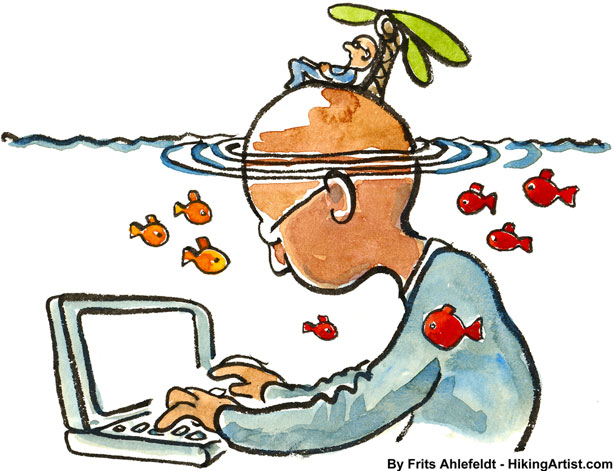 Some people and personality types are more creative than others, there is no question about that fact. However, everyone is creative no matter how it's defined. Many just don't think of their skills as creative.
Their reasons are numerous. One I'd like to remove from the list comes from too tightly defining what creativity is.
Some people and personality types are more creative than others, there is no question about that fact. However, everyone is creative no matter how it's defined. Many just don't think of their skills as creative.
Their reasons are numerous. One I'd like to remove from the list comes from too tightly defining what creativity is.
Creativity is finding a new way to fund R&D. Creativity is setting up a network to better utilize your hardware or help your staff. Creativity is hiring the people who will lead your company 10 years from now. Creativity is looking at a problem from a different perspective. Creativity is finding a way to do something - when a common path is blocked.
You'll notice that I didn't mention anything about marketing, design or the arts. Certainly that is how many define creativity, and those are valuable pursuits, but they don't hold exclusive rights to creativity.
To unleash creativity and action in your organization, make a point to publicly redefine creativity. Then, encourage new thinking about old processes. You'll be delighted by the results.
Consistency may make you remarkable!
If you are relentlessly consistent people will notice and reward you. Shoot, you'll be a hero! Think of all the times and situations when you value consistency.
- Policy application at a company with whom you do business
- The umpire's strike zone
- Driving your car - or how others drive theirs
- Policy application at your company
I know there are many more or subsets of those above, but you understand the point.
We tend to notice when someone is inconsistent because it upsets the balance. We calibrate our expectations based on experience. When that experience changes, we get confused. If it changes in a negative way, we get frustrated. The converse it also true.
Notice I said 'someone' is inconsistent. I didn't say a company is inconsistent because it is individuals that make consistency decisions. A company that recognizes inconsistency in their staff will train accordingly and reap the benefits.
This week look for ways you or your company can become more consistent. Then, take steps to make it happen. Both your bottom line and your customers will love you for it.
Truth, Lies and Stories
I don't know about you, but I really don't like it when someone tells me something that is factually true, but is untrue when the full context of the situation is known. This is not a political article, although political ads provide plenty of examples of trying to persuade by withholding the complete truth. From my point of view this is worse than a straight out lie - because the communicator is attempting to manipulate you by telling part of the story.
Politics certainly does not have a corner in the lying market. Plenty of companies stretch the truth a little or a lot.
Nothing will damage your reputation or brand more quickly than lying. People will find out and when they do they will not be happy. Chances are they will tell A LOT of people about the falsehood and your brand.
Be straight forward and honest in all of your dealings and you will be rewarded. Own mistakes, tell the truth, and have a great product or service. Customers will flock to you.
Now, it is important to remember that you don't have to make buying decisions for customers with your honesty. I've seen companies attempt to be so transparent that they nearly talk customers out of buying something even though the customer would benefit from the product.
Present the product fairly. Be straight forward, but the role of marketing is to entice interest and inform. If you have a concern you want to be discussed when a customer calls - make sure it is on the campaign summary you provide to sales people, so they discuss it with customers (or at least make sure the issue is understood) before the sale is finalized.
A veteran sales person shared this with me long ago and I have not forgotten it: always tell the truth, it's easier than trying to remember who you lied to!
Marketing is trivial
I had something else planned for today, but it seems trivial now. I'm not devaluing learning and growing in your profession as a marketer, salesperson or executive. But, I want to be somewhat more personal.
Events recently in Aurora, CO or in Evansdale, IA and Penn State need to make us pause  and consider how we treat one another. Further, if we know someone is struggling - a little or a lot, we need to act. First to help them and second to protect others. Helping doesn't need to be filled with drama; often small acts may redirect someone's path in a better direction for them and ultimately others.
We live in one big community, and while we have our different customs and priorities, people want largely the same things: Opportunities for success and safety for themselves and their families.
We are all in a position to help someone and sometimes the moment to help comes up quickly. Other times you can see it coming and prepare. Regardless, please take the opportunity to help those you touch using compassion and persistence.
They will benefit. You will benefit and others you don't even know may benefit.
Thanks for all you do. Blessings to all.
Process = Success
If you implement anything more than a few steps long you have a process. Done well a process is your friend. It helps marketers or  executives to insure you cover important bases and don't miss things. A good process is not static and improves over time.
An example from my daily work is our review process for newsletters - both electronic and printed. The process has saved us many times from making errors both BIG and small. We use similar processes for campaign themes and various other projects, as well. It works like this.
executives to insure you cover important bases and don't miss things. A good process is not static and improves over time.
An example from my daily work is our review process for newsletters - both electronic and printed. The process has saved us many times from making errors both BIG and small. We use similar processes for campaign themes and various other projects, as well. It works like this.
- We prepare and send a "First Look" which is mock up of the piece. It might have full stories and graphics in some places and ideas for stories in other places. It prompts the discussion.
- We prepare the newsletter based on feedback and send what is a 98% complete document to make sure the content we've developed follows the feedback/discussion provided in the First Look session. We state this is not polished, but should be close and we talk about any holes that still need filling (the 2%). We ask for a keen eye review.
- Following comments/suggestions/corrections, internally we do what we call the FTC (fine tooth comb). This is a detailed review where you re-read every word and you need to be in full editor mode. After writing and laying something out - often you can't see the forest for the trees, so you need extra keen eyes at this point.
- After FTC, we send the final out for approval. If someone finds something, we fix it. Most often, it is approved and we order.
This process works because it has been developed over time and everyone knows what to expect. We use it consistently and participants know what is needed at each step. It makes it easier for all involved AND we get the best results because of it.
What processes do you use to make your tasks easier to accomplish? An advice to make our process better? I love to learn.
Clarity in the sales process IS the sale!
Clarity IS the sale, and clarity may take many forms. Too many sales people, or maybe more importantly, management, do not appreciate this.
Make it easy to understand = customer buys.
this.
Make it easy to understand = customer buys.
Make it confusing = customer ignores you or moves on to buy from someone else.
Selling really is this simple. But, we make it more complicated all the time. I understand that some products or services are complex. Honestly, that doesn't really matter.
If the seller is transparent (demonstrates trustworthiness) the buyer will pick up the cue. It is easy to be clear when you are trustworthy.
Is it somewhat scary for the seller to be vulnerable? Absolutely!
Is it necessary in order to be overwhelmingly successful in any type of sales. Yep.
Often, the scary part for sales people is they don't want to be transparent enough to allow clarity to happen, so they skirt issues, they mitigate their speech, or use industry jargon for cover. The adage goes - if you can't convince them, confuse them.
Customers, not wanting to be 'taken,' are on guard all the time. They'd love to be open, but experience has taught them not to say too much for fear of losing leverage.
If you've ever had the pleasure of a transparent sales person, you know the comfort that feeling provides. Start building an organization of transparent sales people today. Your customers and your bottom line will thank you for it.
What baseball can teach you about being a better marketer!
I’ve heard many people say “baseball is so slow” or “baseball is boring.” If I know them, I'll ask why they  feel that way. Usually the answer is similar to “there is so much standing around.”
I’ll admit I was practically born on a baseball field and I love the game. Certainly not everyone has that same experience. However, there is a lot the game can teach marketers if we see what is really happening with every pitch.
feel that way. Usually the answer is similar to “there is so much standing around.”
I’ll admit I was practically born on a baseball field and I love the game. Certainly not everyone has that same experience. However, there is a lot the game can teach marketers if we see what is really happening with every pitch.
Baseball is a game of fundamentals and planning. So is marketing.
Baseball is a game of strategy and patience. So is marketing.
Baseball is a game of subtlety and adjustments. So is marketing.
A fundamental example: if a base stealer’s footwork is bad, he will need to be one step faster than someone with perfect fundamentals to steal a base. If a marketer doesn’t engage staff early by asking questions and using their feedback, your campaign/promotion won’t be as successful as if you had.
A strategy example: there are (at least) 5 more ways to score if a runner is on second or third base, so you will see team sacrifice an out to move a runner up. It is basic baseball strategy, based on numbers. As a marketer you need a strategy and then you need to follow it. Too often I see a lot of wishing and hoping. Have a well-considered strategy. Use it patiently. Judge it carefully.
A subtle example: professional baseball players are great defenders too. They make hard plays look easy. Why? Because they were positioned correctly or they anticipated where the ball would be hit based on the pitch thrown or the hitter’s tendencies. They or their coaches notice small things and adjust accordingly. Baseball is a game of constant change. Marketing is exactly the same. Your ability to adjust in the short and long term is what will make your success.
See, baseball is not slow or boring when you know what to watch. Enjoy!
You get more bees with questions!
Sales. Team building. Marketing. Or, just getting along with others. This skill will assist you in  many areas.
Today there are numerous ways to interact with people. Facebook. Phone calls. Email. Skype. And yes, even face-to-face. This method will work with all of them.
many areas.
Today there are numerous ways to interact with people. Facebook. Phone calls. Email. Skype. And yes, even face-to-face. This method will work with all of them.
It has nearly miraculous warming effects on people. The better you get at this the more positively people will think of you or your company. They’ll remember you. You likely will make more sales and build more brand equity. You'll probably be happier too.
What is this wonder skill? Questions.
Ask questions in a kind and polite manner and doors will swing wide open for you.
It takes sincerity. Failure may be painful because false sincerity is worse than rudeness. Consistency is needed to prove your sincerity at times.
If you show an interest in the people, remember names and use them to address those in which you speak, you’ll stand out and be remembered. Remember the sincerity rule here because you don’t want to be ‘that guy’ that over does this.
People care about their own interests and wants. That is not a fault; it’s just a fact. They might need what you have, but given the choice they’d rather get it from someone who is interested in them.
Done right. You’ll get more bees with questions. I promise.
Pricing, packages, bundles. Are they right for you? Yes? Start here.
I do a lot of work with telecommunications companies and it occurred to me that a webcast on 'bundling' I did for them last year might have some  value to others. The concepts can certainly extend to many other industries, in fact, they are quite interesting when viewed through this lens.
So if you are interested in pricing and bundling your products or services, you might want to scan this. I'll include a link to the slide deck at the end of this post.
value to others. The concepts can certainly extend to many other industries, in fact, they are quite interesting when viewed through this lens.
So if you are interested in pricing and bundling your products or services, you might want to scan this. I'll include a link to the slide deck at the end of this post.
So, what are the initial questions you want to ask yourself before you dive into bundling or a pricing restructure? Here are a couple to get you started:
- Do you have the margin for it? Sometimes bundles just don't make sense. If they are not for you, don't push it.
- Do you have capacity? This can be defined however you want: time, inventory, capital, etc.
- What are your competitive pressures? Simple question. How does competition affect your pricing?
- What are the goals for your bundling? Simple questions #2. What are your reasons for wanting/needing to bundle?
Reasons to bundle vary. Below are some to consider that MAY apply to you or could if you worked at it.
- Stickiness: in most industries customers in bundles with more products reduces churn significantly!
- Customer expectation: bundles are easy (think Extra Value Meals and 2for1 deals). Customers like them.
- Easier to sell/explain/understand: putting stuff together that makes sense is easy to buy and sell.
- Increase revenue: Often bundles are used to raise Average Revenue per User/Customer.
Be relevant if you decide this approach is right for you.
- Talk about what is important to customer, not what is important to you.
- Create products that show you are concerned about customers needs.
- Educate them concerning products and services they want or need.
Finally, be creative with your creative!
- Be thoughtful about your customer. Use words & graphics that connect to them & pull them in.
- Be consistent with your look & message. About when you are getting bored, they are starting to hear.
- Know the hot buttons and push them. What matters to customers? It shows you care and are listening to them.
Click here to read or download slide deck.
Good luck. Please let me know what questions you asked yourself as you considered this for your industry or business.
Curious George can teach you to be a better marketer
Do you hunger to want to know 'why' about stuff? Not just your 'stuff' or your company 'stuff' but everything? The more curious you are the more likely you are to understand consumers, products and how they connect - or don't.
Be curious about things. It will extend to your thinking about marketing your stuff or leading your team.