
Why you should cheer when a customer objects to price
Many of the sales people who I have the pleasure to work with would not include sales in their description of what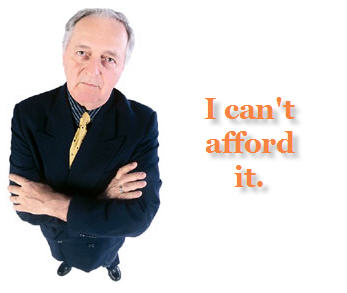 they do for a living.
Most are in the broader category of customer service, which requires a strong set of diverse skills. They view themselves in a service role more so than a sales role. This is fine because it fits their personality and the needs of their customers well - most of the time.
they do for a living.
Most are in the broader category of customer service, which requires a strong set of diverse skills. They view themselves in a service role more so than a sales role. This is fine because it fits their personality and the needs of their customers well - most of the time.
A problem we often discuss involves a customer objecting to price - and that's not the real problem. The problem comes in the customer service/sales person's reply, which is often 'full retreat' into helping the customer figure out how to save money, when that might not be:
a) What they came in for or
b) What's in their best interest
It certainly isn't what is best for the company.
When a customer objects to price it's the first sign they are ready to BUY the product or service being discussed. That's right, price objection is a buy signal.
Essentially they are telling you, "I want this, but I don't think it has as much value as you think it does. Please explain more about why it has the value you state?"
We might need to recalibrate our hearing on this topic. So we hear what the customer is saying rather than just default to: "I don't want that - it's too much money."
Now, I do recognize that you may end up with a customer not buying because they cannot afford the product, but my bet is it will not be the case for the majority of customers.
Listen to them. Ask them which of the benefits or features they don't understand. Chances are they may not understand them all the first time through, so they are discounting one or more of them.
Get practical. Explain the benefits in a context that matters to them.
You still might not make the sale, but you'll educate and inform that customer. They might go 'think about it' and be back next week, ready to buy.
Give it a shot and let me know how it goes.
Clarity in the sales process IS the sale!
Clarity IS the sale, and clarity may take many forms. Too many sales people, or maybe more importantly, management, do not appreciate this.
Make it easy to understand = customer buys.
this.
Make it easy to understand = customer buys.
Make it confusing = customer ignores you or moves on to buy from someone else.
Selling really is this simple. But, we make it more complicated all the time. I understand that some products or services are complex. Honestly, that doesn't really matter.
If the seller is transparent (demonstrates trustworthiness) the buyer will pick up the cue. It is easy to be clear when you are trustworthy.
Is it somewhat scary for the seller to be vulnerable? Absolutely!
Is it necessary in order to be overwhelmingly successful in any type of sales. Yep.
Often, the scary part for sales people is they don't want to be transparent enough to allow clarity to happen, so they skirt issues, they mitigate their speech, or use industry jargon for cover. The adage goes - if you can't convince them, confuse them.
Customers, not wanting to be 'taken,' are on guard all the time. They'd love to be open, but experience has taught them not to say too much for fear of losing leverage.
If you've ever had the pleasure of a transparent sales person, you know the comfort that feeling provides. Start building an organization of transparent sales people today. Your customers and your bottom line will thank you for it.
Pricing, packages, bundles. Are they right for you? Yes? Start here.
I do a lot of work with telecommunications companies and it occurred to me that a webcast on 'bundling' I did for them last year might have some  value to others. The concepts can certainly extend to many other industries, in fact, they are quite interesting when viewed through this lens.
So if you are interested in pricing and bundling your products or services, you might want to scan this. I'll include a link to the slide deck at the end of this post.
value to others. The concepts can certainly extend to many other industries, in fact, they are quite interesting when viewed through this lens.
So if you are interested in pricing and bundling your products or services, you might want to scan this. I'll include a link to the slide deck at the end of this post.
So, what are the initial questions you want to ask yourself before you dive into bundling or a pricing restructure? Here are a couple to get you started:
- Do you have the margin for it? Sometimes bundles just don't make sense. If they are not for you, don't push it.
- Do you have capacity? This can be defined however you want: time, inventory, capital, etc.
- What are your competitive pressures? Simple question. How does competition affect your pricing?
- What are the goals for your bundling? Simple questions #2. What are your reasons for wanting/needing to bundle?
Reasons to bundle vary. Below are some to consider that MAY apply to you or could if you worked at it.
- Stickiness: in most industries customers in bundles with more products reduces churn significantly!
- Customer expectation: bundles are easy (think Extra Value Meals and 2for1 deals). Customers like them.
- Easier to sell/explain/understand: putting stuff together that makes sense is easy to buy and sell.
- Increase revenue: Often bundles are used to raise Average Revenue per User/Customer.
Be relevant if you decide this approach is right for you.
- Talk about what is important to customer, not what is important to you.
- Create products that show you are concerned about customers needs.
- Educate them concerning products and services they want or need.
Finally, be creative with your creative!
- Be thoughtful about your customer. Use words & graphics that connect to them & pull them in.
- Be consistent with your look & message. About when you are getting bored, they are starting to hear.
- Know the hot buttons and push them. What matters to customers? It shows you care and are listening to them.
Click here to read or download slide deck.
Good luck. Please let me know what questions you asked yourself as you considered this for your industry or business.